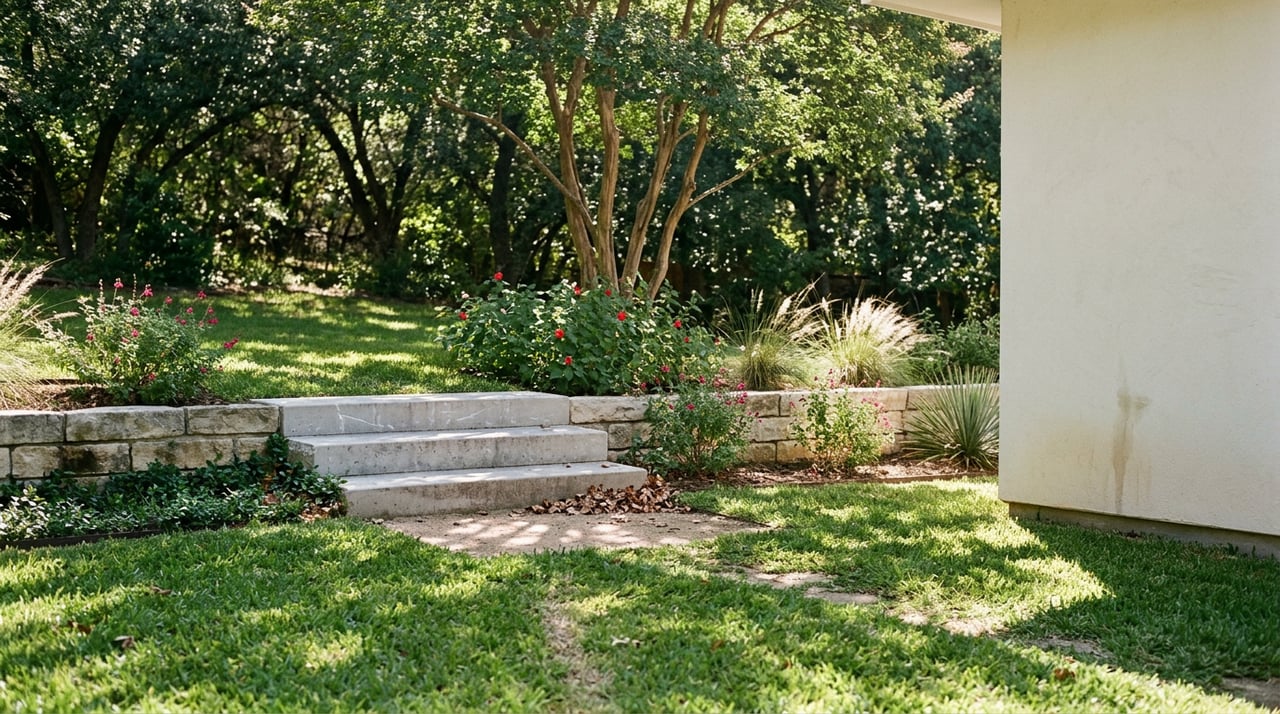
Barton Hills Doesn't Check the Weather to Decide Where to Swim. It Checks a Gauge.
August 13, 2026
August 13, 2026
A visitor pulls up a weather app before heading to Zilker Park. A Barton Hills resident pulls up a number in cubic feet per second. Neither is wrong, exactly, but only one of them tells you whether the swimming hole at the end of your street is actually swimmable today.
That's because Barton Hills sits on top of two entirely different water systems, and most people who don't live here never notice the difference. One is a spring that behaves the same way every day of the year. The other is a creek that can go from a raging pour to a dry limestone bed in the space of a week. The dividing line between them runs close enough to some backyards that residents have learned to read a gauge the way other neighborhoods read a school calendar.
Walk to the end of Barton Hills Drive and you hit a gate. That gate marks the Gus Fruh trailhead at 2632 Barton Hills Drive, where Barton Hills Drive dead-ends by a gated entry. From there the trail drops into the Barton Creek Greenbelt, and within a few hundred yards you're standing at a swimming hole that has nothing in common, hydrologically speaking, with the pool most visitors picture when they think of this part of Austin.
Barton Springs Pool sits at the downstream end of the Greenbelt and is fed by the Edwards Aquifer rather than by the creek, so it holds roughly 68 to 70 degrees year-round no matter what the gauges read, and it's open daily with a cleaning closure on Thursday mornings. Rain or no rain, that pool is the same pool. Gus Fruh and Campbell's Hole, a short walk upstream, are not. They live and die by Barton Creek itself, which means they are only as good as the last rain and only as safe as the days that have passed since.
Flow is measured as discharge in cubic feet per second at three USGS gauges along the creek, and the difference between a good swim day and a wasted walk comes down to where that number sits. Gus Fruh is swimmable across a wide range but is deepest and cleanest at 20 to 60 cfs. Campbell's Hole is more forgiving, with reliable swimming at 15 to 50 cfs.
| Spot | System | Swim window | Access from Barton Hills |
|---|---|---|---|
| Gus Fruh | Barton Creek (rain-dependent) | 20-60 cfs, deepest and cleanest | 2632 Barton Hills Dr. dead-end, or Spyglass access |
| Campbell's Hole | Barton Creek (rain-dependent) | 15-50 cfs, reliable | Spyglass access or Barton Hills Elementary route |
| Barton Springs Pool | Edwards Aquifer spring | Constant, 68-70°F | Downstream, open daily |
The Spyglass access point near Barton Hills Drive is the classic, least strenuous entry to both holes, and the most convenient parking for it is along Spyglass Drive, near Tacodeli. If you'd rather skip the car altogether, another entrance leads through Barton Hills Elementary School, from which you can walk straight down to Campbell's Hole.
As of early this month, the number wasn't in the neighborhood's favor. A live tracker of those same gauges showed Twin Falls, Gus Fruh, and Campbell's Hole down to standing water in the plunge pools, warmer and murkier than when the creek runs, with the trend falling and one of three gauges reading lower than the week before, based on a reading taken the morning of August 5. Translation for anyone walking down from Barton Hills Drive this week: bring a book instead of a rope swing, or just head for the pool instead.
Here's the part that trips up people who don't live this close to the creek. The instinct after a big rain is to assume the swimming just got better. Locally, it's the opposite.
In June, after a heavy rain pushed the creek back up, Austin Parks and Recreation posted that water recreation was not advised in the creek, citing water level, fast speeds, and pollution from storm water runoff. The fuller the creek looks right after a storm, the more it's carrying with it. City guidance backs up what longtime residents already do by habit: the water level depends on current rainfall, and the best time to visit is two to four days after the last rain, not the same afternoon it stops. If you spot debris in the creek in the meantime, Austin Watershed Protection asks visitors to call 311, and staff typically inspects within three business days.
So the good window is narrow on both ends. Too soon after rain and you're swimming in runoff. Too long after and you're back to standing water and a falling gauge. The neighborhood's real skill isn't knowing where Gus Fruh is. It's knowing when.
Living this close to Zilker Park cuts both ways. Earlier this month, on August 5 and 6, the annual Blues on the Green concert series ran at Zilker Park from 7 to 10 PM, and for Barton Hills that meant more than a nice concert a short walk away. Road closures ran from 9 PM until 11:59 PM, and residents saw signage posted a few days before to discourage event parking on their own streets. Ticketing and towing are enforced during those event hours, which is the sort of detail that shows up in a neighborhood association bulletin and nowhere else.
That's not the only park programming shaping the calendar right now. The park's own shuttle route posts extended hours on nights when the Zilker Summer Musical is performing, a run that continues through August 16, which means later crowds and a busier Loop shuttle for anyone walking or driving near the park through the rest of that stretch.
Street parking at Spyglass and Barton Hills Drive has always been tight, which is why this year's biggest infrastructure change matters more to residents than to anyone driving in from outside the neighborhood. Austin finished a three-way traffic-free bridge over Lady Bird Lake this year, with a Wishbone Bridge and Unity Underpass ribbon-cutting on Saturday, February 7, closing the final gap in the Butler Trail loop. For anyone in Barton Hills willing to walk or bike instead of hunting for a curb spot, that bridge opens a car-free route across the lake that didn't exist six months ago.
Put it together and a Barton Hills summer Saturday tends to run in roughly this order:
None of this shows up on a map or a listing photo. It's the kind of knowledge that only accumulates by living close enough to a dead-end street to know what's on the other side of the gate, and close enough to a neighborhood association's email list to know when the roads are closing.
That's the actual case for Barton Hills. Not that it's near a park, which plenty of Austin neighborhoods can claim, but that living here means operating on information the rest of the city doesn't bother to track: a gauge number, a two-to-four-day rule, a bulletin about towing, a bridge that finally closed a gap. Put together, it's less a neighborhood near the Greenbelt than a neighborhood that reads it.
Liz King spends enough time in Barton Hills to know which side of Spyglass Drive to park on and which week the creek is actually worth the walk. If you're curious what else is different about living on this side of the Greenbelt, from the streets to the schools to the swim conditions, reach out and schedule a consultation.
Stay up to date on the latest real estate trends.
With Liz, it’s not just about the sale—it’s about the relationship. She takes the time to understand your goals, then works tirelessly to help you achieve them.