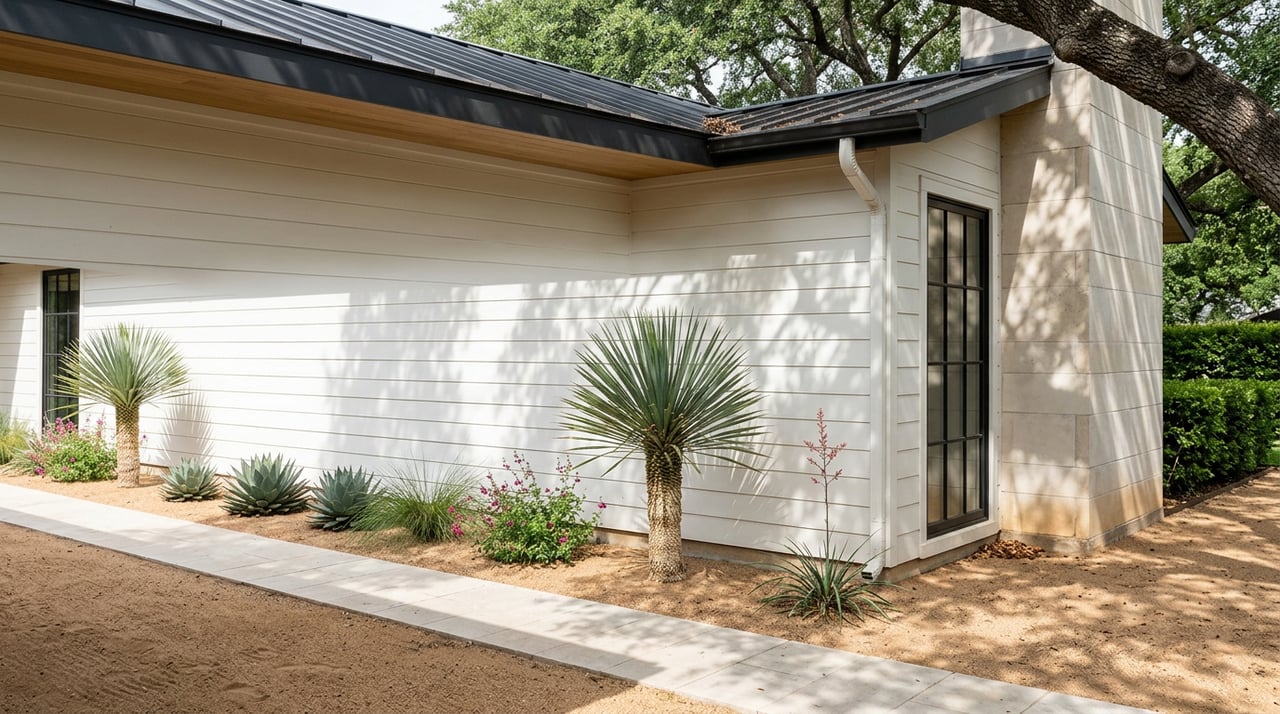
What Your Money Actually Buys in Allandale: Reading the Lot Behind the List Price
July 16, 2026
July 16, 2026
The 1958 ranch on Shoalwood looks like a bargain at $685,000. Original terrazzo, a big pecan out front, a garage that could hold a workshop. Then the inspector pulls a camera through the sewer lateral and finds a partial collapse forty feet from the cleanout. That is a $12,000 line item before the buyer has picked a paint color, and it is the kind of surprise that separates people who understand Allandale from people who bought a house in Allandale.
The wider mistake is treating this neighborhood as a house market at all. Allandale in 2026 is a land market wearing mid-century clothes, and the price of any given listing is really the price of a lot minus what the city and the trees will let you do with it. Read the constraints first and the sticker price starts making sense.
Every Allandale lot sits inside the same regulatory envelope, and every offer is priced against it whether the buyer sees it or not.
Read those four rules against a listing and the price band snaps into focus. You are not paying for the house. You are paying for the lot, the canopy on it, and the delta between what the code will let you build and what is already standing there.
Pull recent Allandale data from three different sources and it looks like they are describing three different neighborhoods. Redfin's May 2025 read showed a median sale price of $880,000 with homes moving in 49 days. Keenan Group's April 2026 snapshot put the median closer to $950,000. Homes.com's trailing twelve months through mid-2026 showed an average sale price of $1,128,469, up 22% year over year, on 47 average days on market.
Those numbers are not fighting each other. They are measuring three different animals inside the same fence. The Redfin median is anchored by resale ranch homes in the 1,400 to 1,800 square foot range. The Keenan mid-$900s reflects the mix once thoughtful renovations enter the sample. The Homes.com average is being pulled upward by new-construction infill at 3,500 to 5,000 square feet, some of which is closing above $2 million.
In Allandale the "median home" is a fiction. The real market is three markets stacked on the same street, priced by what each buyer plans to do to the dirt.
The cleanest way to shop Allandale is to stop reading square footage and start reading intent. Every listing is really an offer to sell you one of four things.
| Price band (2026) | What the seller is actually selling | The constraint that decides the ceiling |
|---|---|---|
| $625K–$775K | An original 1950s–1970s ranch, 1,200–1,700 sq ft, deferred systems | Sewer, roof, electrical, foundation surprises |
| $775K–$1.1M | A permitted renovation on the original footprint | Heritage trees limit how much you can add |
| $1.1M–$1.6M | A larger renovation or modest new build | Impervious cover cap on a 7K–9K sq ft lot |
| $1.6M–$2.2M+ | Custom infill new construction, 3,500–5,000 sq ft | McMansion ordinance sets the envelope |
Travis Central Appraisal District values now show land accounting for roughly 45% to 55% of assessed value on standard Allandale parcels, which is the appraisal district's way of saying the same thing the market is saying. The dirt is doing most of the work.
A buyer looking at a $700,000 ranch in Allandale is really running one calculation: what will this parcel support once I stop touching it and start touching it. Renovation budgets on original ranches in this neighborhood run roughly $80 to $150 per square foot for a kitchen and bath refresh, and full permitted remodels can push well past $250 per square foot once the envelope opens up. A completed, well-executed mid-century renovation in Allandale can resell in the $750 to $950 per square foot range, which is why the renovation submarket is real and repeat.
That is the reason two identical-looking $700,000 listings on the same block can sell at very different speeds. The one with a level lot, no protected trees along the buildable line, and no active neighborhood association design commentary is a builder's parcel. The one with three heritage oaks in the buildable envelope and a partial slab addition from the 1980s is a renovator's puzzle. Same list price, entirely different underwrites.
Named local builders and architects have made the split visible on the ground. Rivendale Homes, Drew Homes, The Muskin Company, SAGO Homes, Wolfe Development, and boutique design-build firms like Chrear are actively delivering 3,000 to 4,500 square foot infill homes, often designed by studios including North Arrow, Mark Odom, SKB Architecture, Studio Celeste, and Davey McEathron. When one of their signs goes up next door to a $650,000 original, the resale ranch is no longer being valued against 1962 comps. It is being valued against the land price a builder was willing to pay to sit next to it.
Two more frictions sit under the surface and are worth checking before an offer, not after.
MLS boundary drift. Homes listed as "Allandale" occasionally sit inside the Crestview, Brentwood, or Rosedale boundaries once you check the parcel against AISD attendance zones. School assignment can shift between Gullett Elementary and Doss Elementary depending on the address, and the Lamar Middle and McCallum High paths downstream are the piece most family buyers are actually paying for. Verify at the address, not the marketing.
Shoal Creek edges. Lots east of Shoal Creek Boulevard sit closest to the greenbelt and the creek. Some fall inside FEMA-designated flood zones that trigger lender-required insurance, and some do not, even on adjacent parcels. The distinction is worth pulling before the option period, not during it.
Permitting time. Additions and teardown-rebuilds move through Austin's Development Services Department on timelines that commonly run six to twelve months. That window is part of the carrying cost of any Allandale project and belongs in the offer math.
Taxes on rising appraisals. The Allandale-area effective rate has moved from 1.8092% in 2023 to 1.9818% in 2024 to 2.0465% in the 2025 tax year. On a $900,000 purchase that is a real annual line item, and it applies to whatever TCAD ultimately assesses, not what you paid.
Is Allandale a buyer's market or a seller's market in 2026? Both, depending on which of the three submarkets you are in. Original ranches in inspection-heavy condition are negotiable and often sit past 45 days. Well-executed renovations in the $900K to $1.3M band move quickly because the buyer pool for turnkey mid-century is deep and repeat. New-construction infill above $1.6M is thinner and more price-sensitive.
Do Allandale homes have an HOA? Most sections have no mandatory neighborhood-wide HOA. A voluntary neighborhood association is active and has engaged the City Council on compatibility standards, but there are no mandatory dues or architectural review committees across the bulk of the neighborhood.
Are ADUs realistic on these lots? Under Austin's current ADU rules, the 8,000 to 12,000 square foot lots common in Allandale are among the better-suited in central Austin for detached secondary units. Impervious cover and tree protection still govern where the structure can sit, which is why the site plan work happens before the design work.
The Allandale buyers who do well in 2026 are the ones who read the parcel before they read the photos. The regulatory envelope is public, the tree canopy is visible from the street, and the sewer scope costs a few hundred dollars during the option period. The buyers who do less well are the ones who fell in love with a kitchen.
If you are weighing an Allandale purchase or preparing a mid-century ranch for sale, Liz King can walk the lot with you, pull the constraints, and price the parcel against what it will actually support. Schedule a Consultation to start with the dirt, not the finish out.
Stay up to date on the latest real estate trends.
With Liz, it’s not just about the sale—it’s about the relationship. She takes the time to understand your goals, then works tirelessly to help you achieve them.